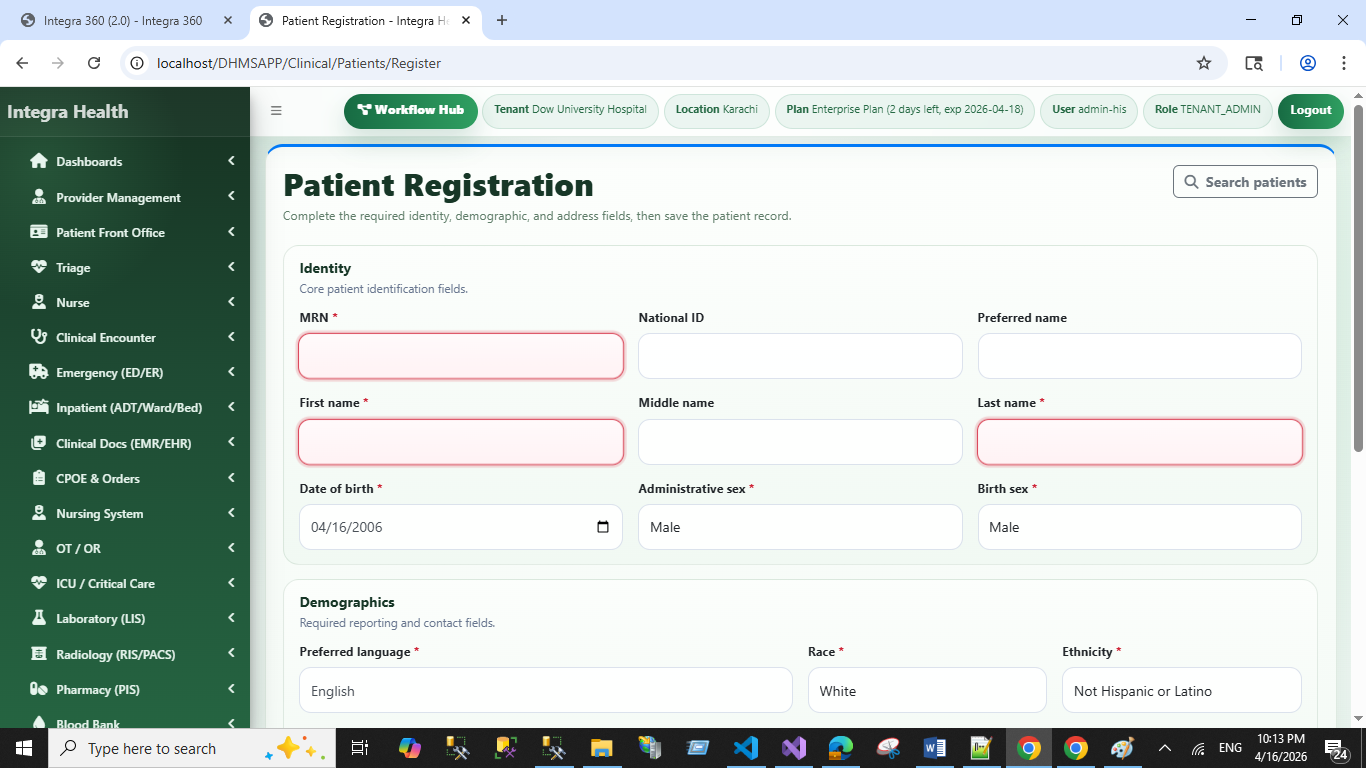
HMIS patient registration screenshot
Patient Registry
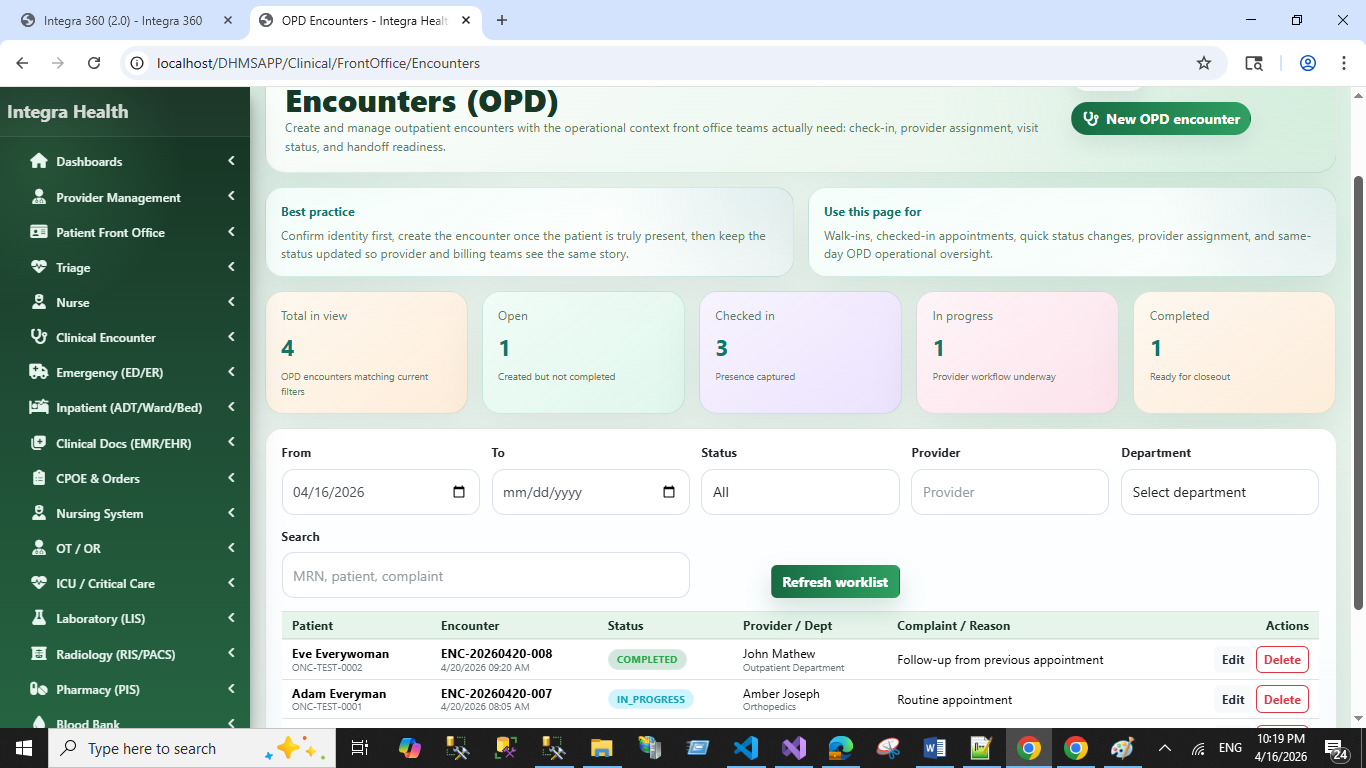
HMIS OPD encounters screenshot
OPD Encounters
01 Workflow clinical operations
02 Portal patient and provider
03 Integrate APIs and data
04 Validate records and claims
05 Audit reports and logs

Healthcare Software Development

Healthcare software for connected, auditable operational workflows.

i-360 develops patient, provider, and administrative portals; clinic workflows; interoperability utilities; claims and lab integrations; document intake; and reporting systems with attention to access control, validation, reconciliation, and auditability.

Healthcare delivery focus

  • Patient, provider, and admin portal development
  • Healthcare API and interoperability workflows
  • Claims, EDI, and lab interface utilities
  • Audit-aware reporting and operational dashboards

Operational Software and Portals

Solutions can support patient, provider, and administrative users; registration and clinic workflows; work queues; documents; dashboards; role-based access; and operational reporting.

Interoperability and Data Exchange

i-360 works on C-CDA generation, validation, import and reconciliation; healthcare APIs; claims and EDI utilities; LIMS connectivity; integration consoles; and traceable exchange workflows.

Administrative AI With Human Review

Approved policies and procedures can support a staff knowledge assistant, while referral documents can be classified, checked, and prepared for review. Uncertain categorization and clinical decisions remain with qualified staff.

Representative healthcare deliverables

An engagement can provide a working portal or operational module, an interoperability utility, a referral intake and review workflow, a scheduling communication workflow, a governed policy assistant, a claims or lab connector, audit-aware reports, test evidence, deployment documentation, and user guidance according to the approved scope.

i-360 does not claim HIPAA certification. Compliance obligations, legal interpretation, clinical governance, hosting controls, and organizational policies remain subject to the client’s requirements and qualified advisers.

Practical Examples

Administrative healthcare workflows these services can support

These examples describe operational assistance, not autonomous clinical decision-making. Final capability depends on approved policies, source-system access, identity and consent requirements, data quality, security controls, testing, and qualified staff review.

Healthcare Knowledge & Policy Assistant

What the client receives

  • Secure staff access
  • Approved document repository
  • Healthcare-specific knowledge assistant
  • Source references
  • Document version visibility
  • Role-based access
  • Feedback and correction controls
  • Usage logging
  • Deployment and training

Tangible deliverable

A working internal healthcare knowledge assistant for authorized staff.

Business value

  • Reduce repeated staff questions
  • Improve onboarding and consistency
  • Reduce time searching manuals
  • Support operational compliance
  • Preserve institutional knowledge
  • Reduce reliance on individual employees

Best suited for

Healthcare operations teams with approved policies, procedures, training material, and authorized staff who need faster access to current operational guidance.

Front-desk support

Staff can ask what information a new patient requires, how cancellations are handled, which form is needed, or when a case should be escalated.

Referral department

Staff can retrieve approved guidance on required referral documents, missing insurance information, responsible departments, and escalation procedures.

Billing operations

Authorized users can ask about the internal process for rejected claims, incomplete billing records, supporting documents, and follow-up steps.

Employee training

New employees can use approved content to learn procedures, department responsibilities, software instructions, privacy requirements, and escalation pathways.

Healthcare Referral Intake Automation

What the client receives

  • Referral intake channel
  • Document classification
  • Patient and referring-provider data extraction
  • Required-field checks
  • Missing-information flags
  • Review queue
  • Referral routing
  • Processing dashboard
  • Audit history
  • Optional supported integration

Tangible deliverable

A working referral-processing workflow designed to reduce manual document handling.

Business value

  • Reduce manual data entry
  • Shorten referral turnaround time
  • Reduce incomplete referrals
  • Improve work-queue visibility
  • Reduce lost or delayed documents
  • Improve operational reporting
  • Let staff focus on exceptions

Best suited for

Healthcare organizations that receive repeated referral documents and need structured intake, missing-information checks, staff review, routing, and status reporting.

Missing-information detection

If a referral lacks date of birth, insurance information, requested service, or provider signature, the workflow can identify the missing fields and create a follow-up queue.

Referral routing

The system can identify an approved referral category and route it to the appropriate department for staff review.

Data-entry assistance

Selected referral information can be extracted and prepared for approval before it is sent to the client’s application.

Referral status reporting

A dashboard can show referrals received, pending review, incomplete, average processing time, and overdue cases.

Patient Scheduling & Communication

What the client receives

  • Appointment-request workflow
  • Selected web chat, SMS, email, portal, or voice connection
  • Patient-information collection
  • Scheduling integration where available
  • Confirmations and reminders
  • Cancellation and rescheduling handling
  • Preparation instructions
  • Staff escalation
  • Communication history
  • Operational reporting

Tangible deliverable

A working appointment communication and scheduling workflow for the selected channels and supported integrations.

Business value

  • Reduce missed calls
  • Reduce front-desk workload
  • Improve appointment response time
  • Reduce no-shows
  • Improve patient communication
  • Support requests outside office hours
  • Improve communication tracking

Best suited for

Healthcare organizations handling frequent appointment requests, reminders, cancellations, rescheduling, or missed-call follow-up through supported communication and scheduling systems.

Appointment request

The workflow can collect name, contact information, preferred date, appointment type, and provider preference, then present supported options or create a staff review request.

Reminder automation

Approved reminders can include preparation instructions, location details, cancellation options, and confirmation requests.

Rescheduling request

The workflow can collect a new date request, check available options where integration permits, and update or escalate the request.

Missed-call recovery

When staff cannot answer, the system can create a follow-up task and send an approved message through the configured communication channel.

Start a Conversation

Describe the healthcare workflow and systems involved.

Share the authorized users, current process, source and destination systems, supported standards or APIs, sample documents, validation rules, audit needs, security requirements, and human review points.

Book a free consultation

Healthcare Software FAQ

Planning healthcare operations and integration software

Can i-360 build patient, provider, and admin portals?

Yes. The scope can include role-based access, workflow screens, documents, status views, communication, administration, and reporting based on the client’s requirements.

Can i-360 work with C-CDA and healthcare APIs?

i-360 has portfolio work involving C-CDA generation, validation, import, reconciliation, Direct and FHIR-oriented workflows, as well as healthcare API and integration utilities.

Can referral intake be automated?

A workflow can classify referral documents, extract selected fields, identify missing information, create a review queue, route work, and report status. Qualified staff should review uncertain or clinical decisions.

Can a healthcare assistant answer policy questions?

Yes. An authorized knowledge assistant can retrieve from approved policies and procedures with source references and access controls. It is an operational support tool, not an autonomous diagnostic system.

Does i-360 claim HIPAA certification?

No. i-360 describes healthcare integration experience and compliance-aware architecture support but does not claim HIPAA certification.

What affects healthcare integration feasibility?

Feasibility depends on vendor access, supported standards and interfaces, documentation, test environments, identity and consent requirements, data quality, security controls, and client governance.

Free consultation